

Key Takeaways
- Financial and administrative challenges faced by small practices can be overcome by integrating a reliable EHR.
- Modern EHRs provide advanced AI solutions to automate documentation and optimize practice efficiency.
- Small practices are also turning to modern EHRs to get a competitive edge in the healthcare industry.
Small Practices Face Multiple Operational Efficiency Challenges
Here are some of the biggest headaches physicians often encounter in operating small practices, reducing their EHR efficiency, too! Read on to find out why they even matter!
1. Financial Pressure and Revenue Leak
As a physician and small practice owner, you must be struggling to keep up with evolving certification, documentation, and billing. But do you know that, amidst all this, your system often gets under-optimized for revenue cycle performance? That is mainly due to incorrect submissions and claim denials!
If you’re spending more time chasing payment or cutting back because margins are tight, your clinical focus suffers. You might sometimes even begin questioning whether “going independent” was the right call.
2. Administrative Workload
Doctors become doctors to treat patients and not to drown in paperwork. Yet for many small practices, the back-office load is heavy. A study on healthcare administrative workload found that traditional EHRs in small practices have endless check boxes and rigid templates.
And such poorly designed EHR systems often halt the tasks at hand. Instead of quick, natural notes, you’re faced with mountains of clicks and screens.
3. Physician Burnout
If you are a physician running a small practice, you must wear multiple hats. You're working as a clinician, manager, marketer, and HR person. That takes its toll!
A 2025 study on physician burnout reveals the factors that increase the risk of burnout. It shows that the system‑level burdens like documentation, small practice EHR tasks, and admin burden likely raise the risk of burnout.
If the physician is burnt out, the practice suffers! Quality drops, recruitment gets harder, patient experience declines, and you begin questioning your choice to run a small practice.
4. Expensive Technological Integration
Technology should be the cool sidekick of your practice, but if you’re running a small clinic, it can feel more like a money‑draining setup. If you try to install full‑blown systems like an electronic health record (EHR), billing and scheduling software, or telehealth platforms, the costs add up fast.
For example, some studies on the financial implications of EHR show smaller practices spending anywhere from US $15,000 to US $70,000 per provider just for EHR setup. And this is too much for small practices to spend on mere testing.
5. Market Pressure
Despite exceptional healthcare delivery, small practices face mounting pressure from large healthcare organizations.
Modern healthcare systems with an expansive physician network often benefit from large budgets. This eventually threatens the survival of small independent practices that are rarely run by more than 10 physicians.
Market pressure means you might lose patients to hospital-owned practices, face tougher insurer contracts, and feel “squeezed” just to keep pace. But fortunately, there are some EHR software features that every small practice can leverage to improve its efficiency.
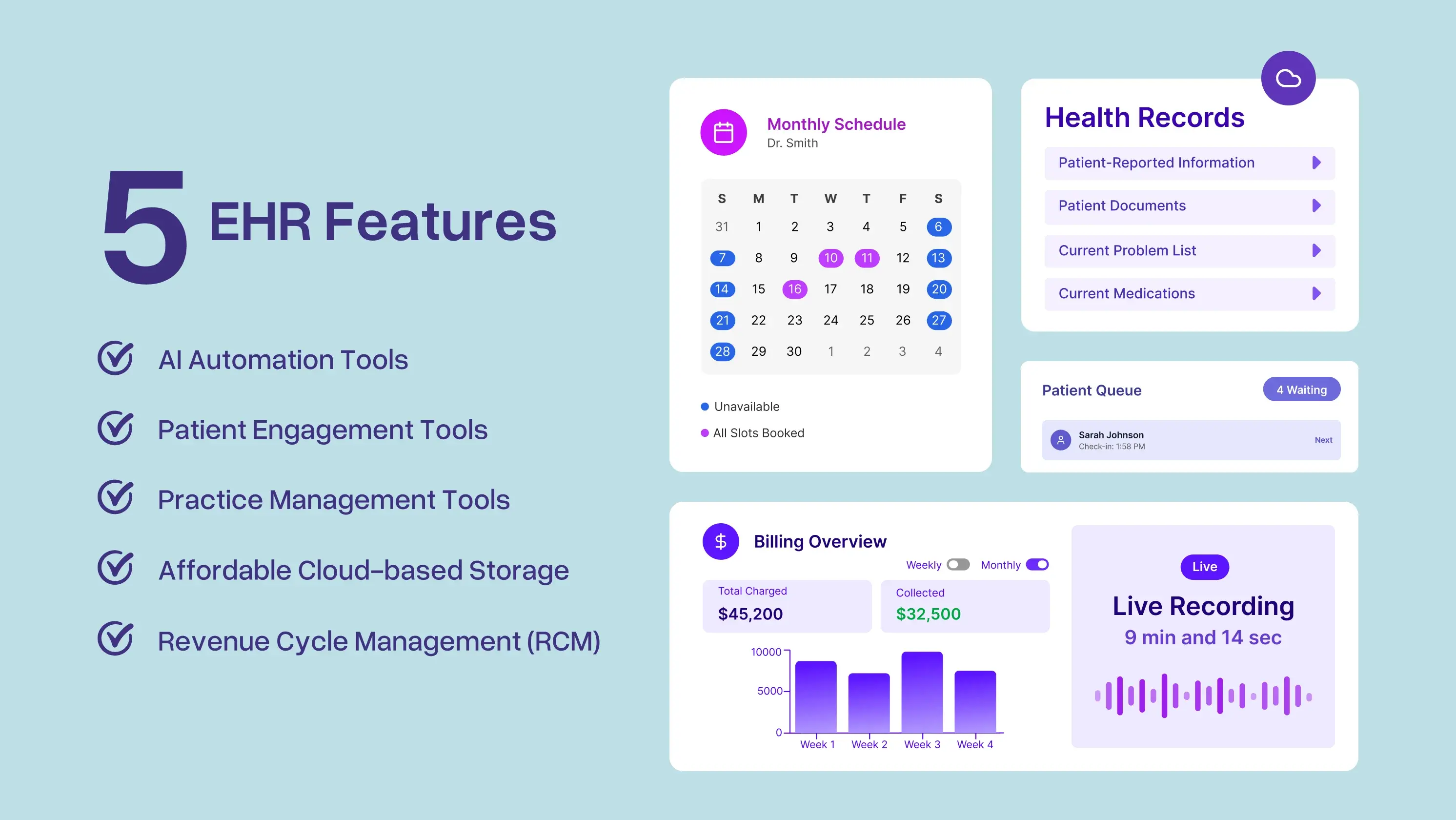
Five EHR Features That Make Life Easier for Small Practices
Running a small medical practice these days can become a mess in no time. You’re caring for patients, managing staff, keeping up with compliance rules, and still trying to make the numbers work.
That’s where the right Electronic Health Record (EHR) system can make all the difference. Here are the top five EHR features that can help optimize efficiency in small practices!
1. Revenue Cycle Management (RCM)
Revenue leak is one of the biggest challenges that you might be facing in your practice. Revenue leaks and claim denials can quietly drain profitability. But the best part is that a reliable EHR with essential RCM features can help you streamline your revenue cycle management and amplify your profitability.
Here’s how RCM, a strong EHR feature, can optimize your revenue:
- Integrated Medical Billing Solution: Ensure no money is left on the table with an integrated approach of proven technology and expertise to manage the full scope of revenue cycle work.
- Integrated Clearing House: Achieve better profitability with a powerful clearinghouse working on the backend to reduce errors automatically and streamline claims management.
- AI Claim Editing Tools: Strong EHRs integrate an AI claim editing tool for smooth and faster claim submissions. An AI claim editing tool does this by reviewing the claims and catching any errors before submission.
- E-Verification Tool: Reliable RCM software also integrates an E-verification tool for real-time coverage verification. It increases staff efficiency and practice profitability by simplifying patient insurance eligibility checks.
2. AI Automation Tools
Endless paperwork and clicks can make you feel buried sometimes. But that “EHR click fatigue” doesn’t have to steal time from your patients. Strong EHRs come with robust AI automation tools to make documentation effortless.
- AI Document Scanner: An AI document scanner automatically reads and extracts key information from scanned documents like the driver’s license and the insurance card. All this process takes less than 5 seconds, reducing the workload on the physician.
- AI Medical Scribe: AI medical scribes listen to your patients while you give them proper attention. Meanwhile, the AI scribe tool generates structured clinical notes at the end of the visit. According to an internal survey conducted by PracticeEHR, AI scribe increased patient engagement by 56%.
- AI Fax: An AI fax sorting tool alleviates physician burnout by automatically reading and scanning the incoming faxes. It extracts the information to detect which category the fax document belongs to and attaches it to the relevant patient record.
3. Practice Management Tools
Physicians running small practices often handle multiple tasks, managing roles such as those of managers, administrators, and IT support. But all-in-one EHRs do not let their users get bogged down by this administrative work.
Practices that offer intensive outpatient programs (IOPs) benefit from configurable scheduling, recurring appointments, specialty-specific templates, and integrated billing and offer following EHR features:
- Patient Kiosk: Instead of filling out forms manually upon arrival, your patients can enjoy a self-service check-in Kiosk system to provide important information. That means fewer calls, fewer paper forms, and less time chasing missing information. Staff can focus on clinical tasks, while patients stay engaged and informed.
- Televisit Services: For busy practitioners who can’t be office-bound all the time, the best EHR for small practices provides remote access. This specific EHR feature allows you to conduct virtual appointments smoothly, so you can see more patients without leaving your practice.
- Specialty-Specific Templates: Specialty-specific EHRs provide customizable templates tailored to various specialties to enhance documentation efficiency. This allows doctors in small practices to spend less time clicking and more time on clinical decisions that matter most.
4. Affordable Cloud-based Storage
Worried that upgrading to a cloud-based EHR system will drain your budget? Modern cloud-based EHR systems can be powerful yet affordable, giving your practice room to grow without extra headaches.
- Cloud-Based System: Your team can work from anywhere, and IT maintenance isn’t one of the headaches when you choose a cloud-based EHR system. Security updates and backups occur in the background, allowing you to stay compliant without lifting a finger.
- Modular Pricing: Pay only for what your practice actually needs, like telehealth, patient engagement, or specialty modules. Budget-friendly flexibility means smarter spending without compromising care.
5. Patient Engagement Tools
Competing with larger health systems requires tools that strengthen patient relationships and reputation.
- Patient Portal: Patient portals that support online scheduling and automated communication boost patient satisfaction and retention.
- Telehealth Integration: The best EHRs for small practices offer telehealth integration to promote health accessibility and improve patient satisfaction.
With the right EHR, small practices can deliver personalized, efficient care. That’s how you can stay competitive in a rapidly changing healthcare landscape.
Optimize Efficiency in Your Small Practice With the Right EHR Features
At the end of the day, you want to see your practice thrive regardless of its size. The above-mentioned features are crucial in choosing the right EHR for your practice. You can spend less time clicking through screens and more time focusing on your patients.

PracticeEHR stands among the most reliable EHRs in the market. With advanced AI solutions, PracticeEHR supports healthcare performance optimization for small practices providing its users with the much-needed automation across every corner of the practice.
FAQs

.svg)
